

Warning, long post.
This week on The Self Publishing Show, Cissy and I are talking about metadata in the new era. During my note making I came to the conclusion that this is even more profound than we first thought and it very likely requires remedial action on our books’ listings.
That chore we faced before; subtitles, keywords, categories is now the way your book explains itself, not to readers, but to machines.
For years, we’ve told authors that metadata matters. Usually, what we meant was fairly practical: choose the right categories, fill in your seven keyword boxes, write a decent book description that ‘sells’ your novel, make sure your subtitle is doing some useful work, and don’t accidentally bury your book in the wrong part of the Amazon store.
Amazon now has Rufus, its own AI shopping assistant. Readers are increasingly using conversational search. Recommendation engines are getting more sophisticated. Ad platforms are using more automated targeting. Meta ads, Amazon Ads, and AI-driven discovery tools are all trying to work out what your book is, who it is for, and when it should be shown to someone.
That means your metadata is doing more than helping with search.
It is helping AI understand your book.
In this article I’ll set out the new approach I believe we need to take.
Metadata is your book’s machine-readable identity
Let’s narrow it down to two principles:
We are replacing advertising with truth.
We are replacing maximum audience appeal with niche.
In the old world, metadata helped answer one main question:
Can a reader find my book?
In the new world, it has to answer a slightly different question:
Can a machine understand exactly what kind of book this is, and who might want to read it?
A vague blurb may have hurt you before but now it means certain invisibility. This is especially important for fiction, where readers are often not just buying ‘a book’. They are buying a specific reading experience.
They might want:
a fast-paced British military thriller
a cosy village mystery with humour and warmth
a dark romantasy with dragons and enemies-to-lovers tension
a psychological thriller about a marriage falling apart
a Cold War spy novel with authentic period detail
a police procedural led by a damaged detective
The more clearly your metadata communicates that experience, the easier it becomes for both readers and AI systems to understand where your book belongs.
AI discovery is more conversational
Readers do not always search in neat keyword phrases.
They may not type:
“British military thriller ex Royal Marine”
They may ask something more conversational:
“What’s a fast-paced action thriller with a former soldier as the hero?”
Or:
“Find me a book like Jack Reacher but with a British feel.”
Or:
“I want a cosy mystery series set in a small town, with humour, friendship and not too much gore.”
The search isn’t just a single sentence, it will become a conversation in which the reader will narrow down their optimal book. AI systems are built to deal with this kind of language. But they still need information to work with. Your book page, reviews, categories, keywords, subtitle, series information and author data all become part of the cloud of information around your book.
So the question becomes:
If an AI had only your book page to work from, would it understand your book correctly?
If the answer is ‘unsure’, your metadata needs work.
The blurb has two audiences now
Yes, readers will still use your blurb etc to make their human choice, that has not changed.
But the metadata also has to explain the book clearly enough for machines to interpret it.
That does not mean writing robotic copy. It does not mean stuffing in keywords. It does not mean flattening your blurb into a dull list of tropes.
It means being clear.
A blurb for the new era must communicate:
genre
subgenre(s)
protagonist
setting
central conflict
stakes
tone
reader promise
relevant tropes or hooks
For example, this kind of line gives both the reader and the machine useful information:
A fast-paced British action thriller about a former Royal Marine pulled into a deadly conspiracy.
That is doing a lot of work. It tells us the pace, nationality/flavour, genre, protagonist type and broad story engine.
Compare that with:
When the past returns, everything changes.
That might sound dramatic, but it says almost nothing. It could be a romance, a thriller, a family saga, a ghost story or literary fiction. It might create mood, but it does not create clarity.
And in the AI age, clarity matters.
Stop thinking of keywords as hacks
One mistake authors make is treating Amazon keywords as a little box of tricks.
The better approach is to treat them as reader-intent labels.
You are not trying to trick Amazon. You are trying to describe the book accurately enough that the right reader can find it. Think truth not selling.
Weak keyword thinking looks like this:
thriller, thriller book, best thriller, crime thriller, action book, suspense novel
Better keyword thinking is more specific:
British military thriller
former Royal Marine action thriller
fast-paced revenge thriller
special forces conspiracy thriller
short action thriller novella
ex-soldier hero thriller
Specificity beats generic noise.
The best keywords are not necessarily the most obvious ones. They are the phrases that connect the right reader to the right book.
Categories are classification signals, not just chart opportunities
Categories have often been treated as a tactical game.
Which category is easiest to rank in? Where can I get a bestseller tag? Which niche has the least competition? Those of us who are fans of the data guys like Alex Newton and Dave Chesson have long used their analytics to predict the above.
But there is now a greater danger than ever before in chasing categories that do not truly fit the book.
In the AI-driven discovery world, categories are not just chart positions. They are classification signals.
If your book is a cosy mystery but you place it somewhere that suggests crime mystery, you may get visibility in the wrong place. More likely the system will note the disconnect between data and consumer and your book will effectively be flagged as a poor performer in search results.
The test should be simple:
Would a reader browsing this category be pleased to find my book here?
If the answer is no, you are probably creating confusion.
The whole book page needs to tell the same story
This is where many authors go wrong.
The metadata does not operate in isolation. Your title, subtitle, cover, categories, keywords, blurb, reviews, A+ content and ads all work together.
Or at least, they should.
Imagine this:
The cover looks like literary fiction.
The subtitle says psychological thriller.
The blurb reads like a police procedural.
The keywords target domestic suspense.
The Facebook ad says “for fans of Jack Reacher”.
That is a confused signal.
The reader is confused.
Amazon is confused.
The ad platform is confused.
And confused systems do not produce efficient sales.
The goal is alignment. I’ve been teaching this as the Swiss Cheese model for a while. Make sure your holes are aligned so the maximum number of people flow through each stage.

Your cover, title, subtitle, blurb, categories, keywords and ads should all be pointing in the same direction. They do not need to repeat each other word for word, but they should describe the same reading experience.
Reviews are metadata too
Annoyingly, this is also true.
Your official metadata is what you tell Amazon and readers about the book. But reviews are also part of the information ecosystem.
Reader language matters and now is the time to consider whether you’ve inadvertently mis-sold your book in the past.
If your book description says:
A laugh-out-loud cosy mystery
but the reviews repeatedly say:
Darker than expected
More violent than I thought
Not really cosy
Reads more like a police procedural
then that is important information.
You are attracting the wrong readers. In the new era that will mean attracting no readers.
AI systems can learn from reader language. Even if you cannot control reviews, you can learn from them.
Look for repeated phrases in your reviews:
fast-paced
emotional
gritty
funny
atmospheric
twisty
romantic
violent
cosy
cinematic
slow burn
great worldbuilding
like Reacher
like Agatha Christie
like romantasy with teeth
Those phrases can tell you what readers think your book actually is.
Sometimes your readers understand your positioning better than you do.
It didn’t occur to me for one second that I wrote mysteries. I thought I was writing traditional military thrillers.
But my readers told me otherwise.
My favourite review remains ‘Most boring book ever’! At the time I shrugged, as we’re supposed to, and just assumed the reader was not in the mood.
But not long after, I got a much more helpful 2-star:
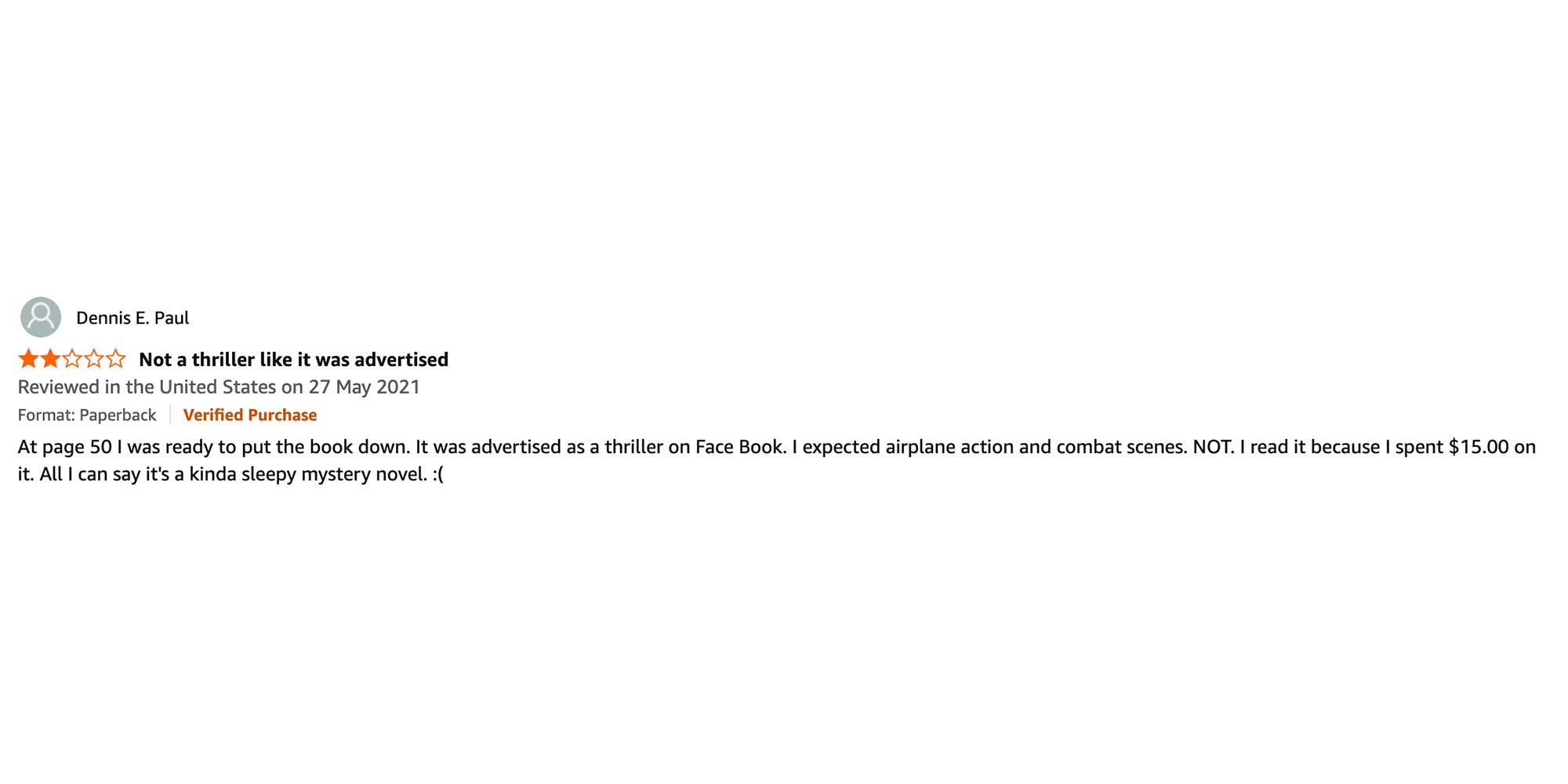
I rewrote the blurb to lean heavily into the mystery aspect of the story using keywords like ‘secret’ and ‘uncover’ and the book did better (it currently has 2,200 ratings at 4.5). But in all honesty I need to go back and start again. In the past a small tweak to the description may have helped, but in the new era I need to be crystal clear, this is a mystery-suspense not an action-thriller or face AI invisibility.
A simple metadata audit
So what can you and I do right now?
Here is a practical exercise.
Take your most important book — usually book one in a series — and write one clear positioning sentence:
This is a [genre/subgenre] about [protagonist] who must [central conflict] before [stakes], ideal for readers who enjoy [tone, trope or comparable authors].
For example, I would write this for Kerry J. Donovan’s Ryan Kaine books:
This is a fast-paced British military thriller about a former Royal Marine who must uncover a deadly conspiracy before innocent lives are lost, ideal for readers who enjoy action-heavy thrillers with tough heroes and military detail.
Now compare every part of your book page against that sentence.
Does the cover support it?
Does the title support it?
Does the subtitle support it?
Does the blurb support it?
Do the categories support it?
Do the keywords support it?
Do your ads support it?
Do the reviews broadly confirm it?
If the answer is no, you have found the problem.
What to fix first
If you are going to audit your metadata, start with these areas.
1. The first paragraph of your blurb
This is prime real estate. Do not waste it being coy.
Make sure the first paragraph gives a clear sense of genre, protagonist, situation and tone.
2. Your subtitle
The subtitle can be a useful classification tool, especially for genre fiction.
For example:
An Acid Vanilla Assassination Thriller
or:
A Ryan Kaine Action Thriller Novella
That sort of subtitle helps readers and systems place the book quickly.
3. Your seven keywords
Replace generic terms with specific reader-intent phrases.
Think about genre, protagonist, setting, tone, trope and comparable reader appetite.
4. Your categories
Make sure you are not chasing visibility in a category that misrepresents the book.
5. Your ad copy
Check whether your ads are promising the same experience as your Amazon page.
If the ad attracts one kind of reader and the product page describes another kind of book, conversion will suffer.
What not to do
The answer is not to stuff your book page with every possible keyword, clarity is more important.
Do not call your book romantasy if it is really epic fantasy with one romantic subplot.
Do not call it cosy if there is violence.
Do not call it a psychological thriller if it is really a detective mystery.
Do not chase fashionable labels unless the book genuinely delivers on them.
This is not just an ethical issue, although that matters. It is a commercial issue. Misleading metadata attracts the wrong readers, produces poor conversion, damages reviews and confuses recommendation systems.
And while that has always been true, in the new era everything is on steroids.
The aim is not to game the algorithm.
The aim is to remove confusion.
Metadata is positioning
The old way of thinking about metadata was administrative. The better way to think about metadata is positioning.
You are telling readers, retailers, algorithms and AI systems what your book is and why someone might want it.
That means metadata deserves proper attention.
It should be reviewed.
It should be tested.
It should be aligned with the cover and ads.
It should evolve as you learn more about how readers respond to the book.
In the old world, metadata helped people find your book.
In the new world, metadata helps machines understand who should be shown your book.
That makes it one of the most important parts of modern book discovery.
And, frankly, one of the easiest things for authors to improve.
A quick homework task
Open the Amazon page for your most important book and ask yourself:
Would a stranger know exactly what kind of book this is within five seconds?
Then ask:
Would an AI that reads every letter and looks at every image on the page, have a crystal clear idea of who to recommend it to?
You do not need to trick the system.
You need to tell the truth about your book more clearly.
That is the new rule of book discovery.
James
This is excellent advice, especially for those of us whose stories have aspects of multiple genres. And for us, this new model is much more helpful than the old keyword/SEO standard. Readers might not know how to search for a book that way, but they can easily ask for a book like one they've enjoyed, or a book with a particular style or vibe. Way better for writers whose work is harder to classify.
Very helpful and informative article--thanks for posting it! I have to say, I really hate writing blurbs and coming up with Amazon keywords. But they're so important, and this just confirmed it all over again.